 Events
  Digital Signage
  Hybrid Events
  Instagram Wall
 Twitter Wall
  TikTok Wall
 Hashtag Campaign
 Social Media Aggregator
 Linkedin Wall
 Facebook Wall
 Studio
 SnapUp
 Spotlight
 Analytics
 Moderation
 Customization
 Reactions
 Photo Booth
 Education
 Fitness
 Hospitality
 Healthcare
 Retail
 Agencies
 Sports
 Finance
 Non-profit
 News & Entertainment
 Ecommerce
 Blog
Blog Support
 Our Clients
 Integration
 Case Studies
 Get Inspired



Hashtag Aggregator – What is it and Why Businesses Use it for Marketing
Author: Upendra Goswami
11 minute read
Table of Content:
A hashtag aggregator is a tool that collects, curates and displays publicly available social posts tagged with specific hashtags from multiple social platforms into a single dashboard or embeddable feed for monitoring, UGC curation, event walls, analytics and campaign reporting.
Why Hashtag Aggregation Matters in 2026
In 2026, social media remains at the core of online discovery, brand storytelling, and user-generated content (UGC). With over 5.07 billion social media users globally, and people spending roughly 2 hours 20 minutes daily on social platforms, the potential for reach is massive. (Source)
Yet this volume brings clutter — tens or hundreds of thousands of posts share generic hashtags, and individual creators or brands struggle to track, moderate, and surface meaningful content. For marketers, event organisers, e-commerce brands, or community-driven businesses, that’s where a hashtag aggregator becomes invaluable.
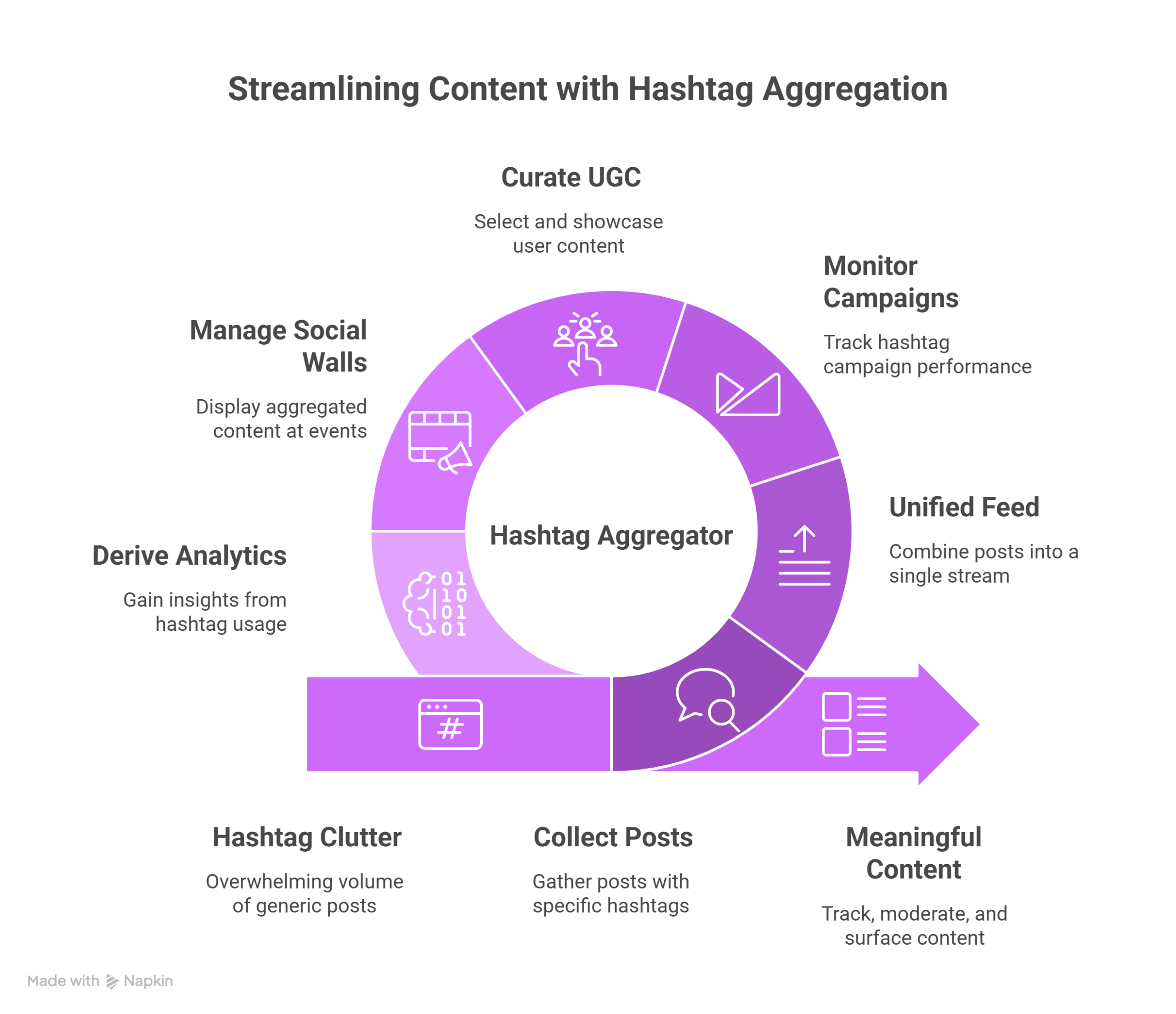
A hashtag aggregator collects publicly available posts tagged with specific hashtags across platforms into a unified feed or dashboard — allowing you to monitor campaigns, curate UGC, manage social walls, and derive actionable analytics.
This guide digs deep into how these tools work in 2026, what features matter, which platforms are supported, and how you can implement them effectively to amplify reach, engagement, and conversions.
What Is a Hashtag Aggregator and How It Works?
Definition & Core Functionality
At its core, a hashtag aggregator tool like Social Walls.com is a software or platform that –
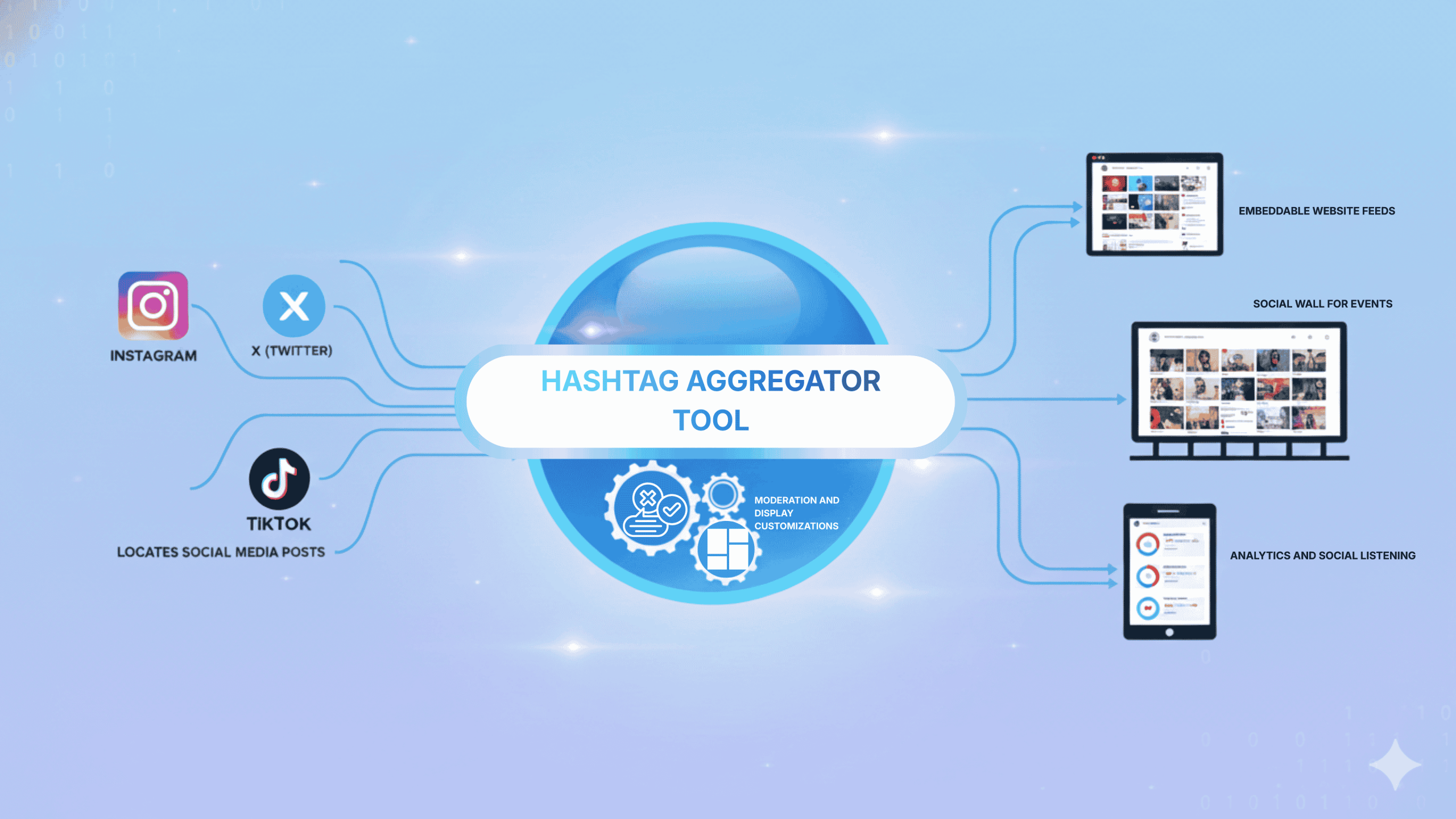
- Locates social media posts containing specified hashtags across multiple platforms (Instagram, X/Twitter, TikTok, etc.),
- Pulls in post data (text, media URLs, metadata such as date, user, engagement),
- Performs moderation or filtering (spam detection, content approval, rights/permission management),
- Presents an aggregated feed — embeddable on websites, usable as “social walls,” or viewable in a dashboard for analytics.
Brands and organizers use these feeds to showcase real client photos, event participant content, campaign-related posts, or to monitor conversation and sentiment in real time.
Unlock the Power of UGC in 2026 with Us
Automatically pull every relevant post with your hashtag and turn it into measurable engagement

 No Credit Card Required
Behind the Scenes – API Access & Platform Realities (2025)
Under the hood, aggregators rely heavily on official APIs — or in some cases, authorised partner integrations — to aggregate hashtag content. For instance –
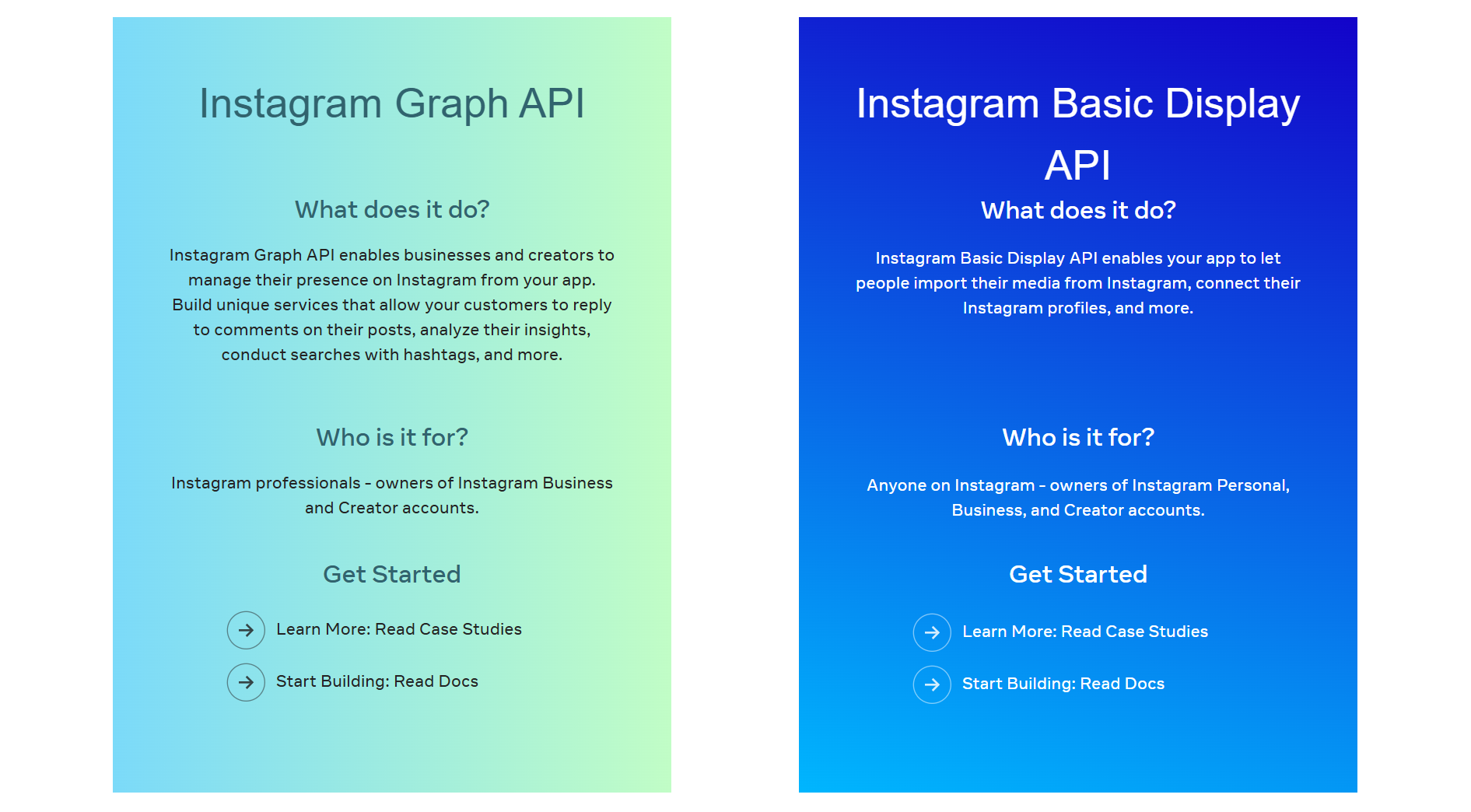
- On Instagram Graph API, a “Hashtag Search” endpoint allows business/creator accounts to fetch media tagged with a specific hashtag.
- The older legacy API (Basic Display Display API) has been deprecated — meaning tools relying on that need to migrate or lose functionality.
Because of rate limits, privacy rules, and the need for business-account authentication, not all aggregators support fetching every type of post (e.g. private profiles, certain restricted content), so always check a tool’s documentation. A Social Media Aggregator like Social Walls support hashtag content from 15+ platforms including Instagram, Tumblr, Pinterest, Facebook etc
Third-party tools sometimes fill gaps — but risk instability due to platform policy changes. That makes choosing a trusted hashtag aggregator like Social Walls with official integrations even more critical.
Do Hashtags Still Work in 2025 — and Why Aggregation Still Matters
There’s been a lot of debate lately about whether hashtags remain relevant. The landscape is evolving, but data suggests that smart, strategic use of hashtags continues to deliver value — especially when combined with aggregation and social-proof workflows.
Hashtag Effectiveness & Engagement Trends
- One recent analysis found that posts with hashtags get ≈ 12.6% more engagement than those without.
- For posts with 9–11 hashtags, reach increased by nearly 79.5% — though this depends heavily on quality, relevance, and platform.
- At the same time, studies caution against over-using hashtags – on some networks, too many hashtags (or irrelevant ones) can decrease engagement or appear spammy.
- For certain platforms (like Pinterest), hashtags are no longer a major ranking or discovery factor — SEO-rich descriptions, titles, and keyword-optimization play a bigger role.
In short: hashtags are not dead — but their utility is now more about contextual relevance, niche targeting, classification, and community building than volume.
Why Aggregation Adds Value Beyond Posting Hashtags
Given that hashtags are still effective but noisy, aggregation offers distinct advantages:
- Curation & quality control: Automatically filter out spam, off-topic posts, and low-quality content; highlight only relevant, high-value content.
- Social proof & UGC for conversions: Instead of relying on stock images or corporate visuals, display real user content as testimonials — boosting trust and authenticity, especially for e-commerce or event-based brands.
- Campaign tracking & analytics: Monitor engagement statistics (post count, reach, top posts), sentiment, and overall performance across channels — giving data-driven insights.
- Live-event or real-time engagement: For events, conferences, product launches — social walls or live feeds encourage attendees to post, engage, and drive broader reach.
In other words – aggregation converts raw social noise into structured, actionable assets.
What to Look for in a Hashtag Aggregator (2025 Checklist)
When evaluating tools, prioritize features that align with current social media and marketing realities.
| Feature / Capability | Why It Matters |
|---|---|
| Multi-platform support (Instagram, X/Twitter, TikTok, YouTube, etc.) | Hashtag trends vary by platform; broader support means deeper reach. |
| Official API integrations & compliance | Ensures stability, data privacy compliance, and uninterrupted access even as platforms revise policies. |
| Moderation & content filters (auto-filter spam/NSFW, manual approvals) | Maintains brand safety and ensures only relevant/high-quality content gets displayed. |
| UGC rights & permissions workflow | Essential when republishing user content for ads, websites, or promotions. |
| Embed/display flexibility (widgets, social walls, digital signage) | Enables multiple use-cases – websites, live events, dashboards. |
| Analytics & reporting (engagement, reach, top posts, trends over time) | Measures ROI, helps optimize campaigns, and supports data-driven decisions. |
| Scalability & rate-limit handling | Vital for large campaigns or high-volume hashtags to avoid breaks or missing data. |
Popular Hashtag Aggregator Tools (2025) — Features & What They’re Good For
Here’s a comparison of several popular tools (with different pricing/models), and who they suit best:
| Tool | Best Use-case / Strengths |
|---|---|
| Social Walls by Taggbox | Comprehensive UGC & social-media aggregator — supports major platforms, moderation, embed widgets, analytics, rights management. Ideal for e-commerce, brand campaigns, event UGC walls. |
| Walls.io | Great for simple social walls & event display. Easy embed + moderation; works well for conferences, concerts, product launches, physical/digital hybrid events. |
| TINT | Enterprise-grade solution: robust analytics, rights management, large-scale UGC campaigns — suited for big brands, global campaigns, multi-channel marketing. |
| Tagboard | Popular with broadcasters, sports teams, and live-event marketers — optimized for real-time displays and high engagement feeds. |
| Free / Freemium Tools (e.g. those listed by Talkwalker) | Good for small brands, low-budget campaigns, social listening or trend tracking without cost commitment. |
Quick pricing note (as of 2025): Basic/freemium plans usually start at a moderate monthly fee (or free with limited data), while enterprise solutions with advanced analytics or rights workflows often require custom pricing — sometimes well into hundreds per month. Always review each vendor’s pricing page directly.
Ready to Try a Hashtag Aggregator That Actually Delivers?
No coding. No complexity. Just plug in your hashtag and watch real posts flow in with full moderation control
No Credit Card Required2025 Platform & API Realities — What Has Changed
Social media platforms continue to evolve — making it essential to stay updated on API changes, algorithm shifts, and platform-specific nuances.
Instagram & Graph API Changes
- The deprecated legacy API (User Token / Basic Display API) was officially shut down — meaning many older aggregators lost Instagram support.
- The current standard is the Instagram Graph API, which supports hashtag search — but only for Business or Creator accounts; private or personal accounts are excluded.
- Because of rate limits and API quotas, a well-architected aggregator must implement caching, efficient data fetching, and backoff strategies to avoid hitting limits.
Hashtags vs. Algorithmic / SEO-based Discovery
- On some platforms (e.g. TikTok, Pinterest), hashtags alone no longer guarantee visibility — platform algorithms now lean more on content relevance, keywords, caption context, alt-text, and user engagement.
- For success, many marketers recommend blending strategic hashtags + SEO-optimized captions + high-quality content + strong engagement signals (comments, shares, saves) rather than relying solely on tags.
Hashtag Analytics & Trend Tracking
Hashtag aggregation is not just for display — it’s also about data. Through proper analytics, brands can:
- Track how many posts a hashtag receives over time,
- Identify peak activity windows,
- Spot top contributors or influencers,
- Evaluate sentiment or content quality (with manual moderation),
- Use UGC as a resource for ads, e-commerce catalogs, or content libraries.
As described by one 2025 “hashtag analytics guide,” this method helps convert raw social activity into measurable outcomes for marketing campaigns.
How to Implement a Hashtag Aggregator for Your Brand or Project — Step-by-Step Guide
Here’s a practical roadmap to set up a hashtag aggregator for your campaign, brand, event or e-commerce store.
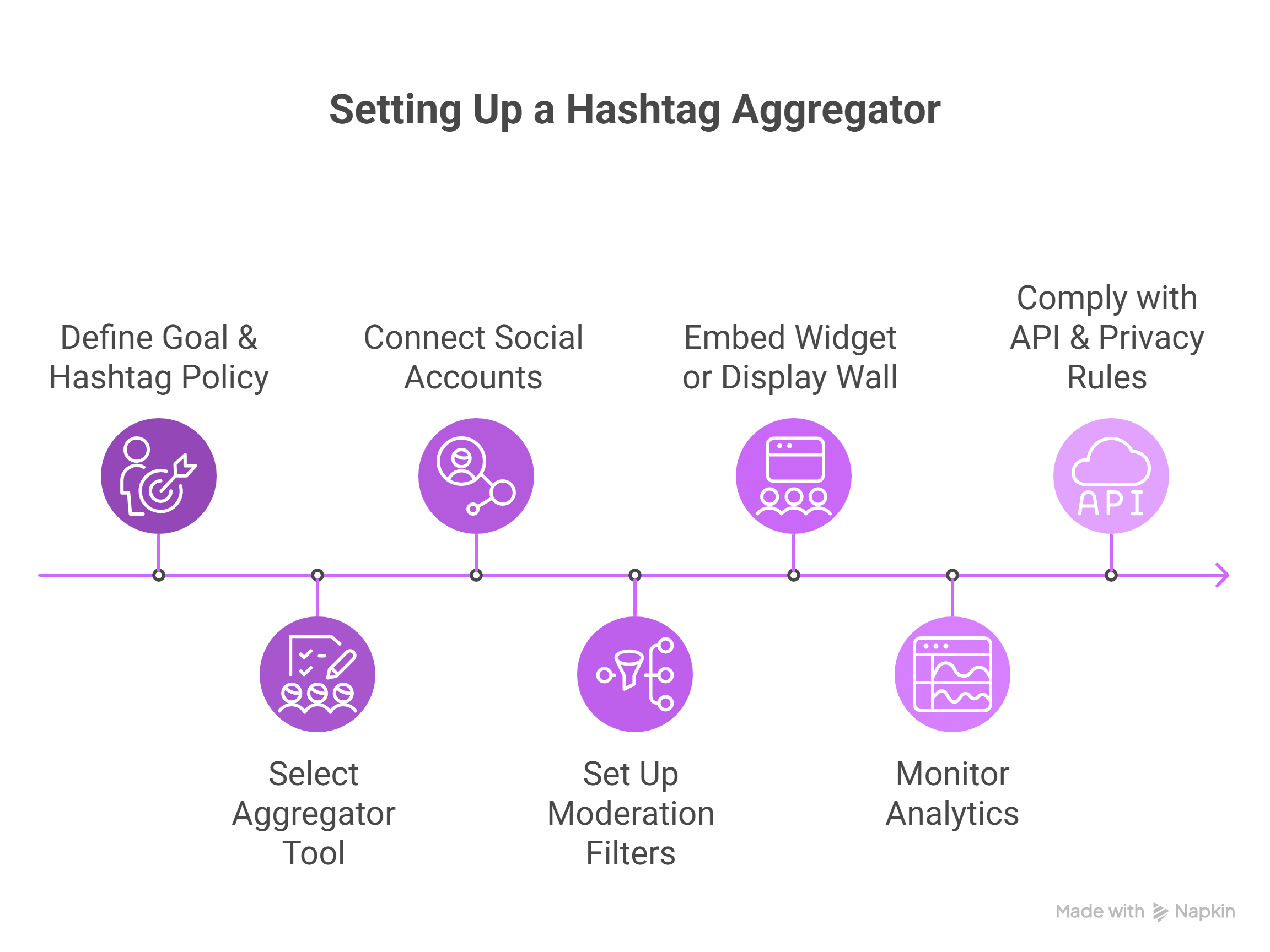
- Define your goal & hashtag policy
- Choose your campaign/event/brand hashtags (branded, niche, or generic).
- Decide what counts as acceptable content — e.g. no spam, no profanity, no NSFW.
- Plan whether you want UGC rights to republish content (ads, website, galleries).
- Select the right aggregator tool based on needs & budget
- For small projects: free/freemium tools or basic social media aggregator tools.
- For brand campaigns or e-commerce: Taggbox, Juicer.io — which offer rights management + analytics
- For events or live walls: Social Walls by Taggbox, Tagboard, Everwall etc
- Connect and authenticate social accounts
- On Instagram: ensure accounts are Business or Creator accounts, connected to a Facebook Page, and permissions granted for Graph API access.
- On other platforms: follow aggregator’s integration instructions (may require API access or partner-level permissions).
- Set up moderation & quality filters
- Include automated filters (spam detection, profanity, duplicate content)
- Enable manual approvals if you plan to repurpose content (ads, website, gallery)
- Embed widget or display a Social Wall
- For websites: use responsive embed code or a plugin (if supported). Try Taggbox Social Widget
- For events: Use a Social Media Wall and test on different displays ahead of time; ensure mobile + desktop compatibility
- Monitor analytics and iterate
- Track post volume, engagement metrics, top contributors, and content quality
- Identify high-performing UGC for reuse in marketing (ads, emails, product pages)
- Adjust filters, hashtag mix, or display style as needed
- Comply with API & privacy rules
- Avoid scraping beyond API limitations; respect rate limits and privacy constraints
- Ensure you have user permission (especially if republishing content publicly)
Use Cases & Real-World Scenarios
E-commerce & Product Pages

Imagine you run a dropshipping or print-on-demand store . You launch a campaign with a branded hashtag like #MyBrandFit.
- Use a hashtag aggregator to collect all posts with that tag — customers wearing/sharing their purchases, reviews, unboxings.
- Filter for quality, moderate, request rights where needed.
- Embed a “Customer Gallery” on your product pages — social proof often increases conversions and trust.
- Bonus: repurpose top UGC in ads, emails, and social campaigns — cheaper than professional photoshoots, more authentic.
Events, Launches, or Live Promotions
Suppose you run a virtual event, webinar, or product launch — or maybe a sale campaign:
- Display a live hashtag wall using aggregated hashtag posts.
- Participants posting with your event hashtag see their posts live — incentivising sharing and engagement.
- After the event, you collect engagement data: number of posts, top influencers, sentiment — useful for reporting or follow-up campaigns.
Brand Monitoring & Sentiment Tracking
Even if you don’t display a social wall publicly, aggregators act effectively as social listening tools:
- Track brand-related or campaign hashtags for sentiment analysis.
- Spot emerging negative feedback or potential PR issues early.
- Discover influencers or frequent contributors organically, to engage or collaborate with later.
Pitfalls & What to Watch Out For
- Platform policy changes: As platforms evolve (API rules, privacy, algorithm updates), aggregators may lose access or need re-approval — always monitor vendor notices.
- Over-reliance on hashtags: With evolving algorithms (especially on TikTok, Pinterest, etc.), tags alone don’t guarantee reach — focus on content quality and context too.
- Privacy & rights compliance: Republishing user-generated content requires explicit permission; always obtain consent for ads or public use.
- Moderation workload: High volume hashtags can generate large numbers of posts — you’ll need manual oversight to avoid spam or irrelevant content.
- Rate limits & quotas: On APIs like Instagram Graph API, heavy use can hit rate limits — ensure your aggregator handles rate limiting gracefully.
Ready to Build Your Hashtag Aggregator?
Set it up in minutes connect your social accounts, curate content, and publish your first live wall today
No Credit Card RequiredConclusion
Hashtag aggregators are not a relic — when used smartly, they remain powerful tools in 2025 for content curation, community building, social proof, analytics, and growth.
Upendra Goswami
Digital Marketing Expert
If you plan to launch an e-commerce store, run campaigns, organise events, or build authority content — investing time in aggregating and optimizing hashtag-based content can pay off significantly.
Recommended next steps for you:
- Choose a tool (start with a free/freemium or mid-tier aggregator). 👉Try 14 Days Free Trial
- Define 2–3 campaign hashtags (brand + niche-specific).
- Run a small test for 1 month — embed a social wall or gallery.
- Analyze results — conversion lift, engagement, social-proof impact.
- Scale up (UGC campaigns, ads, rights-based reuse) once you confirm ROI.
Frequently Asked Questions
-
Are hashtag aggregators legal & compliant with social media rules?
Yes — tools like Social Walls by Taggbox that use official APIs (like Graph API for Instagram) and respect user privacy/data policies are compliant. Avoid scraping or unauthorised data access.
-
Can I aggregate hashtags from private profiles or closed accounts?
No. Aggregators can only fetch publicly available posts or posts from accounts that give permission via API. Private/locked profiles remain inaccessible unless they share content publicly.
-
Do posts with more hashtags perform better?
Not always. Overuse of hashtags often reduces engagement. The key is relevance, quality content, and context. Strategic, niche-relevant tags perform better than random, volume-based tagging.
-
Do I need coding skills to set up a hashtag aggregator?
Not necessarily. Many tools offer no-code setup — connect your social accounts, set filters, embed the feed. For advanced customizations (styling, rights-management, API-based automation), basic developer support may help.

Upendra leads the marketing team at Social Walls, bringing over 9 years of expertise in event marketing and SaaS growth strategies....