 Events
  Digital Signage
  Hybrid Events
  Instagram Wall
 Twitter Wall
  TikTok Wall
 Hashtag Campaign
 Social Media Aggregator
 Linkedin Wall
 Facebook Wall
 Studio
 SnapUp
 Spotlight
 Analytics
 Moderation
 Customization
 Reactions
 Photo Booth
 Education
 Fitness
 Hospitality
 Healthcare
 Retail
 Agencies
 Sports
 Finance
 Non-profit
 News & Entertainment
 Ecommerce
 Blog
Blog Support
 Our Clients
 Integration
 Case Studies
 Get Inspired


Event Marketing Plan – Step-by-Step Guide to Promote & Sell Out Events
Author: Rohan Singh
9 minute read
Table of Content:
Your event can be pure fire, but if nobody knows about it, you’re just throwing a party for the staff. A rock-solid event marketing plan is the difference between “sold out in 48 hours” and “crickets plus free drinks.”
Whether you’re running in-person conferences, hybrid festivals, or fully virtual summits, the game stays the same: get the right people excited, get them registered, and keep them buzzing long after it ends. This guide gives you the exact event marketing plan outline to help you fill venues and crash virtual ticketing pages. Free templates, timelines, channel breakdowns, this blog has everything you need to stop guessing and start winning.
What is an Event Marketing Plan?
An event marketing plan is your master blueprint that turns a date on the calendar into a sold-out (or fully booked) success. It’s the document that spells out who you’re talking to, what you’re saying, where you’re saying it, when, and how much you’re spending to make it happen. Think of it as the marketing version of the event rundown sheet, except this one directly controls registrations, buzz, and revenue. A proper marketing plan for an event keeps the whole team on the same page, stops last-minute panic posts, and makes sure every dollar you spend actually moves the needle.
Bottom line: no plan = gambling. Solid plan = predictable attendance and event ROI you can take to the bank.
Types of Event Marketing Plans
Before we get into the crux of event marketing planning, it is important to
In-Person
Everything is built around the feeling of being there in real life. You push early-bird pricing, local radio, posters in gyms and cafés, and big influencer appearances. At the venue, you set up huge screens with a live social wall pulling every #EventName post. People take selfies, see themselves up there instantly, tag friends, and the whole place turns into free promotion.
Virtual
Here, the sell is “no travel, no cost, still get the full experience.” You hammer email lists, LinkedIn groups, and partner webinars. The trick is to make it feel alive: run a social wall inside the platform so everyone chatting and posting still feels part of one big room, even if they’re on different continents.
Hybrid
You’re basically running two events at once. In-person gets the VIP treatment (limited seats, networking drinks), virtual gets the low-price, watch-from-couch pass. One hashtag feeds two social walls: one on the venue screens, one on the online lobby. Attendees on-site and at home see the exact same energy and keep feeding the hype together.
Pick the type, then follow the same core event marketing plan, just tweak the channels and messaging to fit.
Here is a more organized manner that can help you to get a better understanding of the difference between the three.
| Aspect | In-Person Events | Virtual Events | Hybrid Events |
| Core Promise | “Be there in real life – the energy you can’t get anywhere else” | “No travel, no hotel, still get the full experience from anywhere” | “The best of both worlds – join live or from home” |
| Primary Promotion Channels | Early-bird pricing, local radio & podcasts, posters/flyers in gyms & cafés, street teams, local influencers, geo-targeted social ads | Email sequences, LinkedIn & industry groups, partner webinars, retargeting ads, content upgrades (free previews), global influencer partnerships | All of the above combined – local + global channels running in parallel |
| Audience Engagement Tool | Giant on-site screens with live social wall (#EventHashtag) – selfies instantly appear | Embedded social wall inside the virtual platform (Hopin, Zoom, Remo, etc.) | Single hashtag feeding TWO social walls: one on venue screens + one in the virtual lobby |
| Social Proof Mechanism | Attendees see themselves & friends on the big screen → instant posting & tagging | Chat + reactions + live posts keep energy high → same posting behavior online | On-site and remote attendees see the exact same feed → unified buzz |
| Main Operational Challenge | Venue capacity, logistics, weather (if outdoor) | Keeping energy high when people are alone behind screens | Running two experiences perfectly in sync without neglecting either group |
One Event. Months of Marketing Content
Capture attendee posts, testimonials, & highlights to fuel social media, campaigns, & next year’s event promotions

 No Credit Card Required
How to Create an Event Marketing Plan – 9-Step Process
A successful event needs a perfect marketing plan. Here are your steps to create an event marketing plan
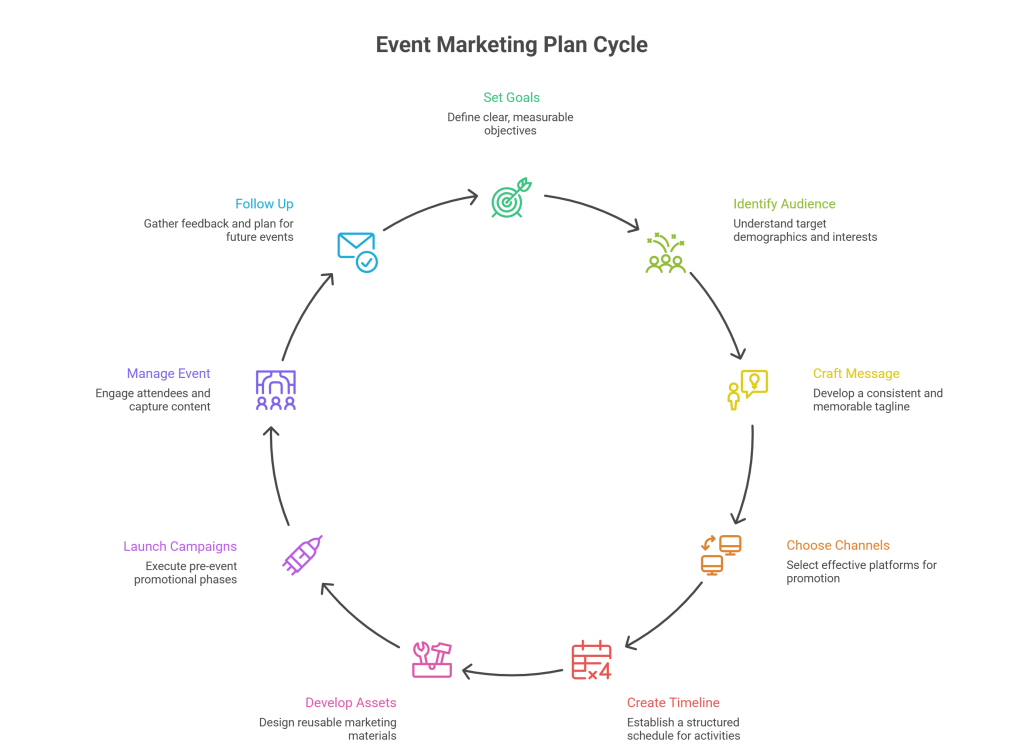
Step 1 – Lock your goals and KPIs
Every killer event marketing plan starts here, or it’s dead on arrival. Write one sentence nobody can misread: “We sell 1,200 tickets at $299 average” or “We collect 400 qualified leads.” Choose three numbers you can pull from the dashboard, no fluffy “brand awareness” nonsense. Revenue, registrations, social reach. I’ve watched events with amazing lineups flop because the team chased likes instead of sales. Nail the goal first, then every decision in your marketing plan for the event has a north star. Miss this step, and you’re just throwing money at pretty graphics.
Step 2 – Know exactly who’s coming
Forget “everyone.” Your event marketing plan lives or dies by two or three tight personas. Example: “Corporate HR managers 38–55 earning 100k+” and “startup founders 25–35 who read TechCrunch.” List their biggest headache, where they hang out online, and what keeps them up at night. Every email subject, every Reel caption, every ad copy now speaks straight to them. Tight audience = higher conversion and way less wasted ad spend in the process of event marketing.
Step 3 – Nail the one big message
One tagline that fits on a sticker: “The only conference that actually grows your revenue” or “Three days, zero fluff, all connections.” That line goes on every banner, email, and social post. Pick three colors, one font pack, done. Your event marketing plan outline now has a personality people recognize in half a second. Consistency is the cheat code nobody talks about in marketing event planning templates.
Step 4 – Pick the channels that actually work
Stop posting everywhere. Choose two social platforms your personas live on, your email list, and one paid channel (Meta, LinkedIn, or Google). Then add a live social wall on the website and venue screen, as it’s free amplification, using tools like Social Walls. Social Walls makes it easy to collect, curate, and showcase social media content on websites, events, and various other platforms. Channels are not a popularity contest; they’re weapons in your event marketing plan.
Step 5 – Build the timeline nobody can mess up
Six months out: save the date. Ninety days: early bird launch. Thirty days: daily countdown. Seven days: last-chance panic. Put every task on a shared Google Sheet with the owner and deadline. Miss the rhythm and your promotions feel random; hit every beat and attendance snowballs. This is the backbone of the entire process of event marketing, no timeline, no control.
Step 6 – Create assets once, use forever.
Week one: bang out speaker quote cards, countdown videos, email headers, hashtag graphics, and social wall widget code. Use Canva templates so the intern can’t screw it up. One folder, everyone grabs what they need. Your marketing event planning template should include an asset checklist; otherwise, you’re redesigning the same graphic at midnight before launch. Do it once, look professional the whole hashtag campaign.
Step 7 – Hit go on pre-event campaigns.
1 Phase: teasers.
2 Phase: speaker drops.
3 Phase: early bird.
4 Phase: social proof (past highlights).
5 Phase: FOMO.
6 Phase: last 48 hours.
Each phase has its own email, ad set, and budget. Your event marketing plan isn’t random posts; it’s a calculated wave that peaks right when registration closes. Miss a phase and you leave money on the table.
Step 8 – Own the day-of energy
Big screens, live social wall pulling every #YourEvent post, photo booths feeding the same feed, and an MC giving shout-outs to top posters. Attendees become your marketing team without knowing it. Day-of execution turns a good event into a legendary one and gives you content for next year. This is where your event marketing plan outline pays off; people leave posting, tagging, and already asking about next year’s tickets.
Step 9 – Follow up fast and milk it dry.
Within 24 hours: thank-you email, survey, replay link, early-bird for next year. Within seven days: highlight reel, best quotes, attendee testimonials. Your event marketing plan doesn’t end when the lights go off; it starts with the next sale. Repurpose everything: LinkedIn carousels, email case studies, website proof. One event, six months of content, zero extra work.
Want This 9-Step Event Marketing Plan Done for You?
Showcase live social posts on screens & websites to boost reach, engagement, & real-time buzz
No Credit Card RequiredEvent Marketing Channels – Digital and Traditional Strategies
Social Media Event Marketing Strategy
Pick the two platforms your audience actually opens every day and own them. LinkedIn + Twitter for B2B conferences, Instagram + TikTok for consumer festivals. Post daily: countdown graphics, speaker Reels, “swipe up to save your seat,” reposts from past attendees. Use one branded hashtag from day one and plug it into a live social wall on your website and venue screens. That wall alone can turn 500 attendees into 500 free promoters. Grab my free social media event marketing plan template, 90-day calendar, post ideas, and exact caption formulas that have sold out three conferences in a row.
Email Marketing and Content Strategy
Your list is still the highest-ROI channel in 2025. Run a six-part sequence: save the date → speaker lineup → early-bird reminder → success stories → last chance → thank you + replay. Segment by persona so the startup founder gets different copy than the corporate exec. Pair it with content marketing: blog posts, lead magnets, and speaker interviews that drive sign-ups.
Traditional & Paid Mix
Local radio and campus flyers still work for festivals, industry-mag ads for niche conferences. Paid ads on Meta, LinkedIn, and Google fill the gaps. Target people who visited your site but didn’t sign up—they’re already interested and far more likely to convert.
Ready to Build a Sold-Out Event Marketing Plan?
See how live social walls & smart promotion strategies amplify reach before, during, & after your event
No Credit Card RequiredConclusion
The difference between a successful and unsuccessful event is a proper marketing plan. The steps mentioned above can help you make your event a huge hit. So what are you waiting for? Utilize an event marketing plan and make your event talk of the town.
Frequently Asked Questions
-
What should be included in an event marketing plan?
A complete event marketing plan contains clear goals and KPIs, audience personas, core messaging and branding, selected channels (social, email, paid), a detailed timeline and content calendar, budget allocation, promotional assets list, social wall integration, email sequences, and post-event measurement framework.
-
How far in advance should you start event marketing?
Large in-person or hybrid events need 6–12 months of promotion. Virtual event or smaller events require 3–6 months. Serious push (daily posts, ads, email cadence) should begin 90 days before registration closes to build momentum and hit capacity.
-
What's the difference between event planning and event marketing?
Event planning covers logistics: venue, schedule, catering, registration flow, and on-site operations. Event marketing focuses on audience acquisition and engagement: messaging, promotion channels, ticket/registration sales, and ROI tracking. Both are essential, but marketing directly drives revenue and attendance.
-
How do you measure event marketing success?
Primary metrics include total registrations/ticket revenue, cost per acquisition, conversion rate from each channel, email open/click rates, organic and paid social reach, social wall engagement (posts displayed), and post-event NPS or feedback scores. Success is defined against the original KPIs set in the plan.

Rohan Singh is a dedicated content associate and writer with a passion for crafting compelling narratives that engage and inspire readers....